

When an MSP bundles VoIP phone service with IT, it might seem like a convenience—for both the MSP and the client. But when things go wrong, it can create confusion, billing issues, and serious service interruptions. In the best interest for all involved, this post will explain why MSPs shouldn’t bundle VoIP with IT services. Let me share a recent example that illustrates what can go wrong when a small business uses an MSP that bundles VoIP in its monthly billing.
We were approached by a small bookkeeping firm that had just given 30 days’ notice to terminate their contract with their MSP. Only after sending their notice to discontinue IT services did they learn that their phone system was part of that same IT contract—and that the phones would be shut off, too. They did not understand that the services were so intricately linked in the service plan that they could not continue VoIP while canceling other services.
To make matters worse, the client had no direct access to their phone system. They didn’t know which numbers were active or how their calls were routed. They were paying for over 30 phone numbers—despite having just five employees—and had no support to help them understand which ones were safe to cancel. The IT company, still technically responsible for their phones, offered no help.
They assumed switching to a new VoIP provider would be simple. But porting numbers and fully migrating to a new VoIP provider can take anywhere from days to many weeks. That kind of transition requires planning—not panic.
This is exactly why RemiPBX works cooperatively with MSPs but always bills the client directly and provides VoIP support independently. We stay within our lane (VoIP) so you can stay in yours to deliver excellent IT and cybersecurity services. And the client never loses control over a critical part of their business: voice communications.
Separating the billing is not only an issue of contract control, but also to remain in compliance. The FCC requires VoIP providers to clearly identify themselves on billing statements. When IT companies bundle VoIP and pass along phone charges, that transparency is lost—and your clients’s phone numbers and voice service may unknowingly be put at risk. Moreover, you (the MSP) can be at risk for compliance violations with the FCC (as well as your VoIP provider).
So what’s the takeaway for MSPs?
Keep voice separate from IT.
Don’t risk client relationships by acting as the middleman for a service you don’t control.
Partner with a VoIP provider like RemiPBX who handles the phones directly—and lets you focus on what you do best.
What’s the takeaway for small business?
Work with your vendors. Read the contracts you sign and if there is something you don’t understand, ask your legal counsel and ask your vendor.
Do not bundle VoIP with your IT services. Your VoIP bill should be fairly predictable month-to-month, so going on autopay can make it easy for you on the administrative side.
If you are thinking about cancelling services, reach out to your vendor. Had the client I described earlier done that, they could have saved themselves the fire drill of quickly onboarding a new VoIP service to avoid service disruption and lost business phone numbers.
We stepped in, helped them sort through the mess, and began planning a port. But it raised a much bigger question:
Why are so many MSPs still bundling VoIP into their services when it clearly puts the client and themselves at risk?
The One Bill Fallacy – Don’t Bundle VoIP
Many MSPs fall into the trap of thinking they need to simplify things for clients by putting everything—IT services, software licenses, and phone systems—on a single invoice.
Bundling VoIP sounds good in theory, but in practice, it’s misleading and often creates confusion. And small businesses understand that all of their technology and communications services are not coming from one bill. Some examples of separate billing can include internet services, cell phone plans, physical security systems, and traditional fax or elevator lines.
Compliance Isn’t Optional
VoIP services aren’t just another software license. In the U.S., they are regulated utilities, and with that comes taxes, fees, and mandatory compliance filings. The FCC requires that the actual VoIP provider clearly identify themselves on the bill, and that all relevant regulatory fees are disclosed and properly remitted.
When an MSP tries to bundle VoIP, they often end up doing one of three things:
- Failing to collect required taxes and fees (putting themselves at legal risk),
- Eating the cost of those fees (hurting margins), or
- Confusing the client about who to call for support, porting, or service changes.
This is why RemiPBX always bills the client directly—and why that’s better for everyone involved.
Four VoIP Selling Models for MSPs (and Why They All Involve Two Bills)
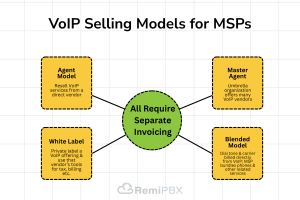
Let’s examine the most common VoIP models MSPs encounter:
1. Agent Model (Direct Vendor Partnership)
You resell for a VoIP vendor. They bill the client. You get a commission. Two bills.
2. Master Agent Model
You partner with an umbrella agency that offers many vendors. They bill the client. You get paid. Still two bills.
3. Blended Model
The dial tone and carrier services are billed directly, but you bundle the software, phones, and support into your MSP invoice. Like selling Microsoft 365—manageable, but still two bills.
4.White Label/Wholesale
You run your own “phone company” and use a vendor’s tools for tax compliance, billing, and number provisioning. Even with your branding, VoIP has its own invoice. Two bills again.
Why Separation Protects Your Clients
Back to the bookkeeper: if her IT company did not bundle VoIP onto her IT bill, her small business wouldn’t have been at risk of losing all service with 30 days’ notice. Instead, the phone system would have been handled separately, with its own provider, its own support team, and a clearly defined porting plan.
This is why RemiPBX works alongside MSPs in a reseller model (Agent Model). We stay in our lane, providing quality VoIP service for your clients, so that your MSP can focus on what it does best.
We find with this model everyone wins – cleaner billing, better service and less headaches for everyone. If you are interested in learning more about the RemiPBX VoIP Reseller Program, contact us today to set up an exploratory call.


